I haven't posted in a while, mostly because I've been busy traveling and teaching. But I'd like to get back to the current weather today briefly, as we have an unusual set of circumstances that's causing some unique weather.
First, anyone who has followed my Facebook status may have noted that Seattle (or, rather, SeaTac airport) reached a record high pressure of 1043.4 mb last night. This extraordinary high pressure supported light winds and clear skies last night, allowing us to cool down into the upper 20s. Pretty cold for Seattle.
But our locally high pressure here is just one facet of the far-reaching consequences of this dome of high pressure. If we check the anomalies in 850mb geopotential height for this morning (which is close enough to the surface to reflect much of the surface pattern), we get a pattern that looks like this:
What is this showing us? Anomalously high heights (which tends to translate down to high pressure at the surface) over much of the northern west coast and into the northern plains and Great Lakes. This is contrasted with anomalously low heights over the southwestern US. We can see that this low anomaly is associated with a low height center in the desert southwest in the actual 850mb map for this morning:
The problem is that when you have anomalously high pressure right next to anomalously low pressure, you get strong pressure gradients. On the anomaly map above, the entire corridor from central California through northern Utah and into northern Colorado is marked by a sharp gradient between these two anomalous centers. This is reflected in a strong pressure gradient at the surface. Here's this morning's surface analysis from the GFS model:
The black contours are the isobars--lines of constant pressure. You can see the sprawling high centered over Seattle contrasted with the low pressure center over western Arizona. In between there are lots of isobars, indicating that the pressure is changing rapidly over that area. Strong pressure gradients mean strong winds, and looking at the wind barbs on that map there really are some high winds in that corridor.
Usually our wind tend to follow what is known as "geostrophic balance". This simply means that winds in the northern hemisphere tend to blow with high pressure (or height) to their right. This also explains the counterclockwise flow around low pressure centers and the clockwise flow around high pressure centers. However, this sort of balance tends to break down near the surface, particularly over rough terrain. The more friction between the air and the surface, the more this disrupts the geostrophic balance. Considering how mountainous the west is, you can see based on the wind barbs in the map above that the winds are blowing more directly from the high pressure in the north to the low pressure in the south. This is just an example of surface friction at work.
The winds still tend to have a slightly easterly component, however, and that has huge ramifications for what that means for the weather. It's causing a lot of trouble in two places.
1) Central and southern California. Easterly or northeasterly winds here are descending down the western slopes of the Sierra Nevada and the coastal mountains of California, accelerating as they do so. Here's a map of the amazing winds currently being reported throughout southern California:
There are several areas with 30+ knot sustained winds being reported, particularly in the central valley and in the mountains just northeast of Los Angeles. Notice how dry the air is too--dewpoints (the blue numbers) are down in the teens and low 20s while the actual air temperatures (the red numbers) are in the upper 50s or 60s. This is another symptom of downslope winds--they tend to be very dry. Some damage has been produced by these strong winds in southern California, as the news outlets are reporting.
2) Upslope flow in the Colorado Rockies. With an easterly component to the winds, that means that air is running into the eastern side of the Rockies and is being forced upward. As that air rises, it cools, condenses, and (because it's cold enough) we get snow. Lots of snow. With strong winds on top of it. Here's the latest surface map from the central Rockies:
Strong 20-40 knot winds are being observed in many locations throughout the mountains. And notice all those little pink asterisks next to a lot of observations in central Colorado? That means snow is falling at that location. The more asterisks, the heavier the snow. So far, between 6-12 inches of snow have been reported in the Boulder area, and it's still coming down. Winter storm warnings and advisories are up for most of the Front Range. It's turning out to be an impressive event.
And all of this is happening--without any real fronts! It just goes to show that we don't need to have our deep lows with powerful cold fronts to still get some impressive weather
Showing posts with label high pressure. Show all posts
Thursday, December 1, 2011
Tuesday, January 4, 2011
Conditions around an "air stagnation advisory"
I've had a busy few days as I returned to Seattle and classes have now resumed at the Univeristy of Washington. This is the first chance I've had to do a new post. Since it has now been several days, I'm going to forgo the upper air analysis of the storm on New Year's Eve (sad, I know...) and press onward...
A lot of people are also posting on the forecast cold air outbreak across the central and eastern US late this week and into next week. This is definitely a big story, and I look forward to getting into it in the days to come. For a preview of this event at the earliest stages of its prediction, I refer you to Patrick Marsh's blog and Chris Whitehead's blog, both of which look into this cold air outbreak.
However, Seattle and much of the west coast looks to be spared this frigid air. In fact, this morning was rather hazy in the Seattle area, but according to the weather service that's not where the big problem area was...
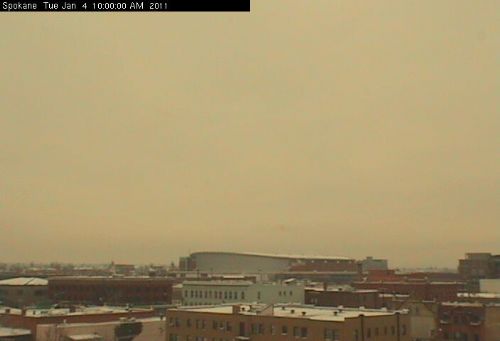
Much of eastern Washington is under an air stagnation advisory throughout the morning. Such advisories are issued when limited air movement and subsident conditions create and environment that traps dust and pollutants within the boundary layer. This can severely deteriorate air quality. Based on this morning's webcams out of Spokane, it looks like that's just what is happening:
It certainly appears that there's lots of red dust or other material in the lower atmosphere. Definitely something to be concerned about.
So what kinds of environmental conditions promote this "air stagnation" that traps pollution? Several things play a roll. First, the topography of the region has a huge impact on whether air gets trapped or not. Eastern Washington is particularly vulnerable to these kinds of events because it sits inside a topographic "bowl" with higher terrain all around.
Note how eastern Washington has mountain ranges or uplands surrounding the entire area--including the Cascades to the west and the Rockies (which are more in Idaho and not on this map) to the east. That entire area is known as the Columbia River Basin as the Columbia River flows along the western and northern borders of that "bowl".
An area of low terrain like that is excellent for trapping air and pollutants because it becomes much harder to evacuate the air due to horizontal advection. At low levels, air will be stopped by higher terrain no matter which horizontal direction it heads. If the lapse rates are very stable (like we see when there is an inversion aloft or widespread subsidence), the air won't be able to rise up and over the higher terrain to get out either. Therefore, absent any strong synoptic-scale forcing, the air in the low levels simply can't get out of the basin.
So do we see those kinds of conditions here today? Here's this morning's 12Z sounding out of Spokane:
Notice that we do have an inversion--several, in fact. From the surface up to almost 600 mb the lapse rates are largely nearly isothermal (with a few embedded layers that area not). In fact, the 700 mb temperature is the same as the surface temperature! This represents a very stable atmosphere--one that is going to resist any kind of upward motion. Furthermore, note the winds in the low levels of the atmosphere--10 knots or less up to 850mb. Such weak winds are not going to do much to move that air and pollution out. Furthermore, weak winds are present within the entire Columbia Basin:
Very, very light winds across the entire region this morning. Cold temperatures too--in the upper teens and low 20s throughout the region. That air is going nowhere.
Let's briefly look at the larger scale to see what's promoting this pattern. Here's the analysis of 300mb winds as 12Z this morning from the UW 12-km WRF:
I'm not the biggest fan of the color scheme on these maps as I would have made the pinks and purple the higher wind speeds instead of the lower wind speeds. But, anyhow, on the map above the light blues and even greens indicate a strong 300mb jet coming out of the north. We can see in the height field that there's a ridge with an axis oriented from the southwest to northeast across Vancouver Island and into central British Columbia. We would infer that this jet is probably anticyclonically curved if it's located along the height contours around the ridge. That would put eastern Washington square underneath the exit region of an anticyclonically curved jet streak. This implies convergence aloft and downward motion--subsidence. No wonder we're seeing such light winds and no air leaving the Columbia Basin--if the net vertical motion is downward, that air is just going to continue to be held in place.
Fortunately this pattern looks to be somewhat progressive and the ridge will soon be replaced by an approaching trough over the northeastern Pacific in the next few days. This should bring some wet weather to the western side of the Cascades and snow to the Columbia Basin.
A lot of people are also posting on the forecast cold air outbreak across the central and eastern US late this week and into next week. This is definitely a big story, and I look forward to getting into it in the days to come. For a preview of this event at the earliest stages of its prediction, I refer you to Patrick Marsh's blog and Chris Whitehead's blog, both of which look into this cold air outbreak.
However, Seattle and much of the west coast looks to be spared this frigid air. In fact, this morning was rather hazy in the Seattle area, but according to the weather service that's not where the big problem area was...
![]() |
| Fig 1 -- Watches, warnings and advisories map for eastern Washington from the NWS WFO Spokane. |
![]() |
| Fig 2 -- Downtown Spokane webcam at 10 AM PST, Jan 4th, 2011. From the Spokane Air Quality website. |
So what kinds of environmental conditions promote this "air stagnation" that traps pollution? Several things play a roll. First, the topography of the region has a huge impact on whether air gets trapped or not. Eastern Washington is particularly vulnerable to these kinds of events because it sits inside a topographic "bowl" with higher terrain all around.
![]() |
| Fig 3 -- Topographical map of Washington state. Greens represent lower terrain while browns represent higher terrain. |
An area of low terrain like that is excellent for trapping air and pollutants because it becomes much harder to evacuate the air due to horizontal advection. At low levels, air will be stopped by higher terrain no matter which horizontal direction it heads. If the lapse rates are very stable (like we see when there is an inversion aloft or widespread subsidence), the air won't be able to rise up and over the higher terrain to get out either. Therefore, absent any strong synoptic-scale forcing, the air in the low levels simply can't get out of the basin.
So do we see those kinds of conditions here today? Here's this morning's 12Z sounding out of Spokane:
![]() |
| Fig 4 -- KOTX sounding out of Spokane, WA at 12Z, Jan. 4th, 2011. From the HOOT website. |
![]() |
| Fig 5 -- Surface observations from eastern Washington at 17Z, Jan. 4th, 2011. From the UW Regional Observations website. |
Let's briefly look at the larger scale to see what's promoting this pattern. Here's the analysis of 300mb winds as 12Z this morning from the UW 12-km WRF:
![]() |
| Fig 6 -- UW 12-km WRF 300mb wind (shaded), temperature and geopotential height analysis for 12Z, Jan. 4th, 2011. From the UW WRF page. |
Fortunately this pattern looks to be somewhat progressive and the ridge will soon be replaced by an approaching trough over the northeastern Pacific in the next few days. This should bring some wet weather to the western side of the Cascades and snow to the Columbia Basin.
Monday, December 6, 2010
Anti-cyclogenesis?--and more lake effect snow
Cold air has surged south all the way to the Gulf of Mexico behind a rather strong cold front this weekend. Freeze warnings are out as far south as Florida with this event. It's a chilly day for most of the northeastern 2/3 of the country:
Note that rather strong cold air advection is still going on behind this front--and those closely packed pressure contours point to some pretty strong winds over the Great Lakes. Several areas of the upper midwest are reporting 20 knot winds out of the west to northwest. Of course, what does lots of cold air moving over the still relatively warm Great Lakes mean? Another lake-effect snow outbreak, of course. Here's a radar composite from early this afternoon.
Lots of lake-effect snow bands oriented parallel to the wind flow. However, the long axis of most of the Great Lakes is not parallel to the wind flow, so instead of one big band of lake effect snow we're seeing several small bands. The only lake that comes close to being oriented in that direction is Lake Huron, and if we check the Canadian radar in Exeter, Ontario, we do see one big dominant band of lake effect snow coming off of Lake Huron. There are several smaller bands as well, though--partially because Lake Huron is such a wide lake compared to the much narrower Lakes Erie and Ontario.
But I already have talked a bit about lake effect snow recently. Right now I want to briefly look at the current upper air pattern to see what's going on over the central US. So--here's a 300mb analysis from 12Z this morning.
A few features stand out on this map, most notably the huge trough sitting over the northeastern US. Note how the surface low center in figure 1 was analyzed up northeast of Maine--away from the main jet streak as shown in this 300-mb analysis. This would tend to support the conclusion that that low is already well-occluded and starting to fill in (the surface temperatures surrounding the surface low are also very similar with no strong gradients--more evidence of an occluded cyclone).
But let's turn our attention to the center of the country. Notice in figure 4 how the analysis has (somehow) drawn a jet streak coming down through Manitoba and into Minnesota. There are not a whole lot of observations supporting this jet streak on this map (and I KNOW Canada has more upper air observations than are being plotted here), so I will assume that this analysis used other supporting data to conclude that there is a jet streak here. Notice the curvature of this jet streak--as air flows through it, it's curving from northwesterly winds to more northerly winds. This is a clockwise curvature of the winds, or anticyclonic curvature (winds around a cyclone go counterclockwise, so clockwise winds are anticyclonic).
Remember out jet streak adage about us seeing strong divergence in the exit region of a cyclonically-curved jet? It turns out that the opposite is true for anticyclonically curved jets. In the exit region of anticyclonically curved jets we expect to see convergence aloft. Since we generally assume air does not rise above the tropopause, convergence aloft generally leads to subsidence and rising pressure at the surface (and often divergence at the surface to compensate). To illustrate, I drew up a quick diagram:
So, whereas in the exit region of cyclonically curved jets we'd expect to see surface lows form, we might expect to see high pressure building at the surface under the exit region of an anticyclonically curved jet--under an area of convergence aloft. We can also see that the central plains is also somewhat under the left entrance region of the straight or slightly cyclonically curved jet streak across the southeast--another favored area for convergence aloft. All of this would theoretically support rising surface pressures. Do we see this?
In looking at a 3-hour pressure change map from this morning, there's really no clear signal across the central US. Lots of zero-pressure-change contours are floating around on the plains. We don't see strong pressure rises. However, we do see strong winds picking up across the upper midwest, conveniently starting somwehwere in southern Minnesota and northern Iowa and blowing eastward toward the surface low in the Canadian maritimes.
We usually don't focus on the formation of high pressure centers--they're somewhat tricky and they don't usually bring "interesting" weather. There are many things that could be going on here to explain why we aren't seeing pressure rises. Here are my thoughts on a few of them:
![]() |
| Fig 1 -- Objective analysis of surface temperature (colored shading), sea-level pressure (contours) and winds for 18Z, Dec. 6 2010. From the HOOT website. |
![]() | |
| Fig 2 -- Base reflectivity composite image for 1818Z, Dec. 6, 2010. From http://www.weather.gov/radar. |
| Fig 3 -- Base reflectivity from Exeter, Ontario (WSO) radar at 1830Z, Dec 6, 2010. From the Environment Canada website. |
![]() |
| Fig 4 -- 300mb analysis of winds and geopotential height at 12Z, Dec. 6, 2010. From the HOOT website. |
But let's turn our attention to the center of the country. Notice in figure 4 how the analysis has (somehow) drawn a jet streak coming down through Manitoba and into Minnesota. There are not a whole lot of observations supporting this jet streak on this map (and I KNOW Canada has more upper air observations than are being plotted here), so I will assume that this analysis used other supporting data to conclude that there is a jet streak here. Notice the curvature of this jet streak--as air flows through it, it's curving from northwesterly winds to more northerly winds. This is a clockwise curvature of the winds, or anticyclonic curvature (winds around a cyclone go counterclockwise, so clockwise winds are anticyclonic).
Remember out jet streak adage about us seeing strong divergence in the exit region of a cyclonically-curved jet? It turns out that the opposite is true for anticyclonically curved jets. In the exit region of anticyclonically curved jets we expect to see convergence aloft. Since we generally assume air does not rise above the tropopause, convergence aloft generally leads to subsidence and rising pressure at the surface (and often divergence at the surface to compensate). To illustrate, I drew up a quick diagram:
![]() |
| Fig 5 -- Luke's somewhat crudely drawn diagram to attempt to illustrate how convergence aloft leads to subsidence and increasing pressure at the surface. |
So, whereas in the exit region of cyclonically curved jets we'd expect to see surface lows form, we might expect to see high pressure building at the surface under the exit region of an anticyclonically curved jet--under an area of convergence aloft. We can also see that the central plains is also somewhat under the left entrance region of the straight or slightly cyclonically curved jet streak across the southeast--another favored area for convergence aloft. All of this would theoretically support rising surface pressures. Do we see this?
![]() |
| Fig 6 -- 3-hour surface pressure changes and wind vectors at 12Z, Dec 6, 2010. From the College of DuPage website. |
We usually don't focus on the formation of high pressure centers--they're somewhat tricky and they don't usually bring "interesting" weather. There are many things that could be going on here to explain why we aren't seeing pressure rises. Here are my thoughts on a few of them:
- High pressure "centers" are usually spread out over a much larger area than low pressure "centers" which are very point-focused. You can even see in figure 1 above how sprawling the high pressure center contour is compared to the very small low-pressure center contour. So while we do have subsidence and general sinking motion, it's spread out over such a large area here that the overall pressure rise due to this sinking motion is minimized or masked by other local effects.
- On a somewhat technical note, in the solution to the geostrophic wind balance equations, a quadratic comes up with different roots depending on if the flow is cyclonic (around a low) or anticyclonic (around a high). When you attempt to calculate these different terms, there actually ends up being a limit for "strong" a high pressure center can get but there is no limit for how "strong" a low pressure center can get (in the theory). So there reaches a point of diminishing returns where increasing the subsidence won't do anything to raise the pressure--it will just increase the winds.
- I really like in figure 6 above how the winds are calm everywhere in the central US except for where they just start to blow eastward across southern Minnesota and northern Iowa--right underneath where we'd guess there was maximum convergence aloft. I strongly suspect that all the subsiding air underneath that convergence is being evacuated out by the winds toward the low pressure center to the east. In this way, there is no net pressure gain because the subsidence is being exactly balanced by those divergent winds evacuating air at the surface. I think this is the biggest reason we don't see much of a pressure rise.
Subscribe to:
Posts (Atom)